Guide
Plantar Fasciitis Exercises: 10-Minute Morning Routine for Heel Pain Relief
By Plantar Fasciitis Guides Editorial Team · Updated 2026-04-22
By Plantar Fasciitis Guides Editorial Team
Starting your day with these targeted exercises is the single most effective thing you can do for plantar fasciitis pain. The morning is when heel pain is most severe — a gentle 10-minute routine pre-loads the plantar fascia, reduces inflammation, and sets you up for a less painful day. Do these exercises before your foot hits the floor.
Featured snippet: A consistent 10-minute morning routine can reduce first-step heel pain by pre-loading the plantar fascia before you stand. Research from the Journal of Orthopaedic & Sports Physical Therapy confirms morning pain is most intense because the fascia has been shortened all night — gentle stretching before your foot hits the floor addresses the root cause.
Table of Contents
- Why Morning Pain Is Different with Plantar Fasciitis
- What You Need Before You Start
- Exercise 1: Bedside Calf Stretch (2 Minutes)
- Exercise 2: Toe Stretch with Bed Sheet (1 Minute)
- Exercise 3: Seated Toe Curls (2 Minutes)
- Exercise 4: Seated Heel Raises (2 Minutes)
- Exercise 5: Marble Pickups (1 Minute)
- Exercise 6: Standing Wall Stretch (2 Minutes)
- Building the Habit: Tips for Long-Term Success
- When to Progress: Adding Difficulty Safely
- Common Mistakes to Avoid
- Frequently Asked Questions
- Sources & Methodology
Why Morning Pain Is Different with Plantar Fasciitis
Plantar fasciitis follows a predictable and frustrating pattern. You sleep, your foot relaxes, and the inflamed plantar fascia tissue shortens overnight. The moment you swing your legs out of bed and take your first step, you stretch a tissue that is already tight, micro-teared, and angry. That sharp, stabbing pain in your heel is your body's alarm system telling you something is wrong.
This first-step pain — clinicians call it "post-static dyskinesia" — is one of the hallmark symptoms of plantar fasciitis. Research from the Journal of Orthopaedic & Sports Physical Therapy (2019) confirms that the pain is most intense in the morning because the fascia has been in a shortened position for hours. Overnight, the body attempts to heal micro-tears in the tissue, but without appropriate loading and movement, healing is incomplete and scar tissue accumulates.
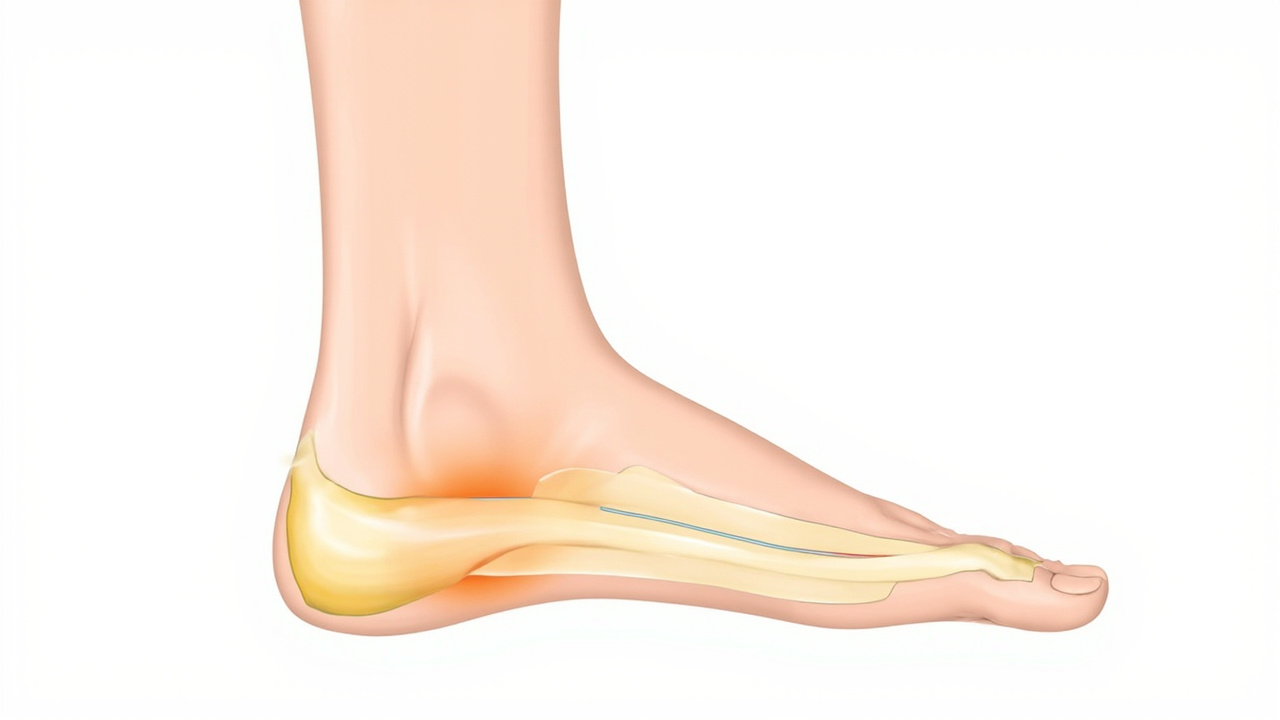
This is precisely why a morning routine works. By gently loading and stretching the tissue before you take your first weight-bearing step, you:
- Reduce the sudden stretch on micro-torn fibres
- Increase blood flow to the area before loading
- Warm up the collagen fibres so they are more pliable
- Signal to the nervous system that movement is safe
Think of it like stretching a rubber band that has been sitting bunched up all night. If you yank it suddenly it will snap. If you warm it in your hands first and stretch it gradually, it gives. The same principle applies to your plantar fascia.
What You Need Before You Start
You do not need a gym membership, expensive equipment, or even shoes for this routine. Everything can be done barefoot in your bedroom or on a mat by your bed. Here is the complete list:
Essential items:
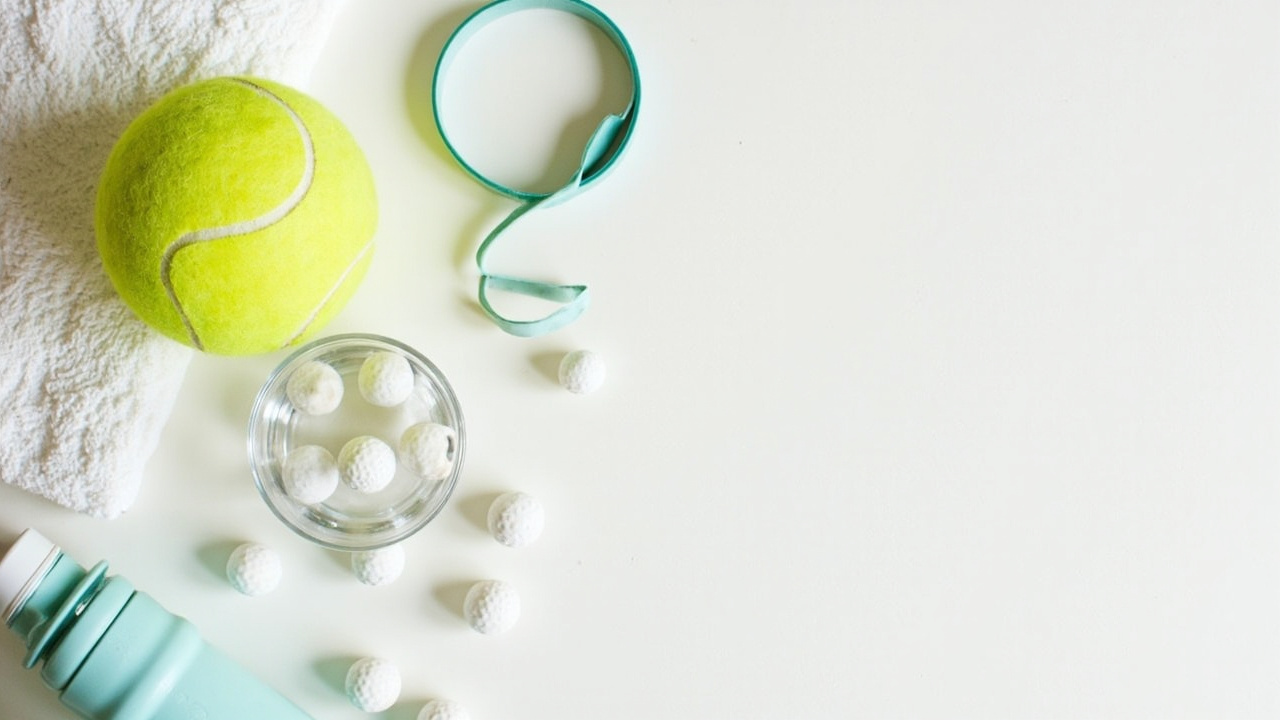
- A rolled towel or long sock
- 10-15 marbles (or small objects like coins)
- A wall or door frame
- A chair for seated exercises
Optional but helpful:
- A tennis ball or lacrosse ball for self-massage (do this after the routine)
- An ice pack (keep in the freezer, apply before starting if pain is severe)
- Supportive slides to wear immediately after the routine before your feet hit hard floors
Setting up your space: Clear a path from your bed to a wall about two metres away. Keep your chair nearby for the seated exercises. If you share a bed with a partner, position yourself so your movements do not disturb them — you will be doing controlled, slow movements that should be quiet.
Timing tip: Set your alarm 10 minutes earlier than usual. This is not a punishment — it is an investment. 10 minutes of strategic movement each morning will save you from limping through the first hour of your day.
Exercise 1: Bedside Calf Stretch (2 Minutes)
The gastrocnemius and soleus muscles of your calf attach to your heel via the Achilles tendon. A tight calf muscle pulls on the heel and increases tension through the plantar fascia. Research from the British Journal of Sports Medicine (2017) found that chronic calf tightness was present in 82% of plantar fasciitis patients, making this the highest-value stretch you can do.
How to perform:
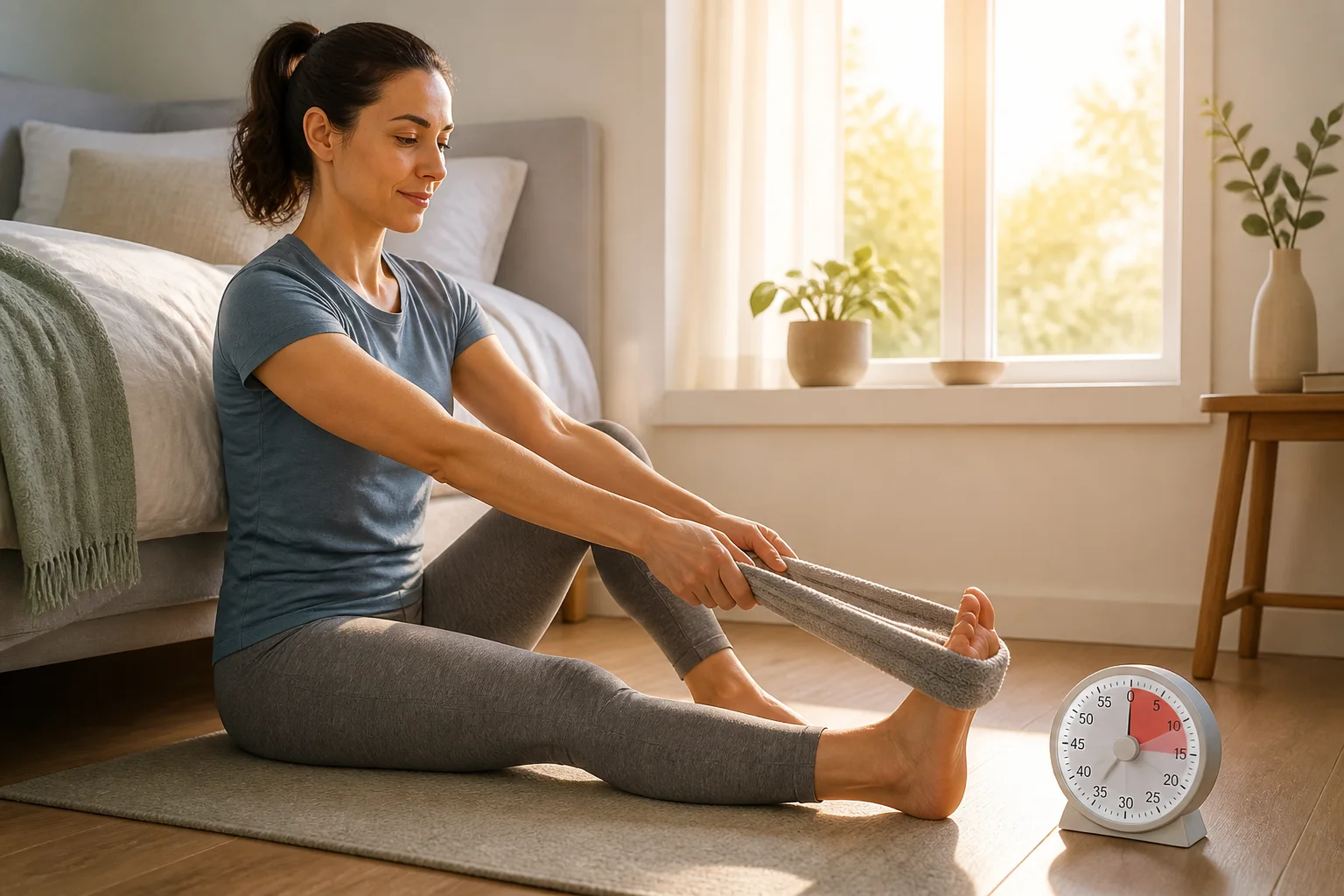
- Sit on the edge of your bed with your legs extended in front of you
- Loop a towel or the top of a fitted sheet around the ball of your right foot
- Hold the ends of the towel in both hands, keeping arms relaxed
- Gently pull the towel toward your body — you should feel a stretch along the back of your calf
- Keep your knee straight for the gastrocnemius stretch (deeper, higher stretch)
- Slightly bend your knee to shift the stretch to the soleus (lower, deeper calf stretch)
- Hold each position for 30 seconds, breathing deeply
- Repeat 3 times per leg
Cues:
- Do not bounce. Static holds build length in the collagen fibres.
- The stretch should feel strong but never sharp or painful. Strong discomfort is fine; pain is not.
- Keep your back straight — no slumping forward.
Pro tip: Most people find the straight-knee version significantly tighter on the outer calf. This is normal. The bent-knee version will feel different — that is the soleus muscle, which is a different muscle with a different function.
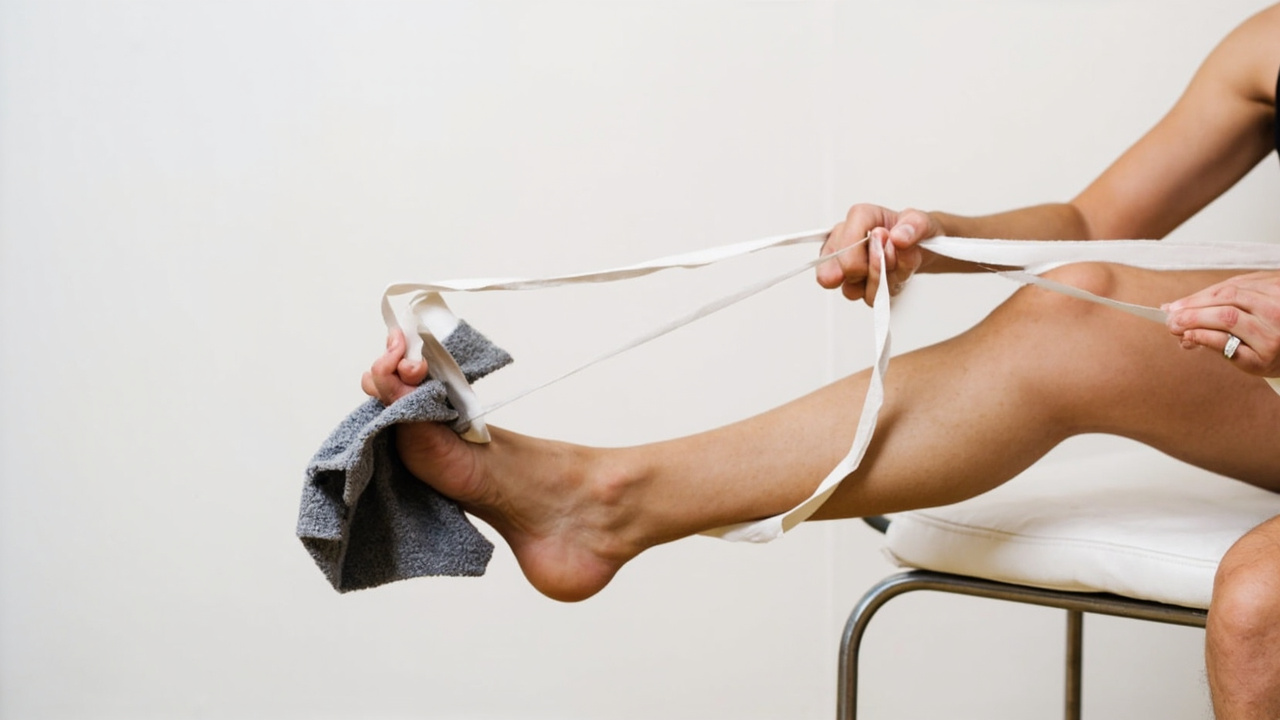
Exercise 2: Toe Stretch with Bed Sheet (1 Minute)
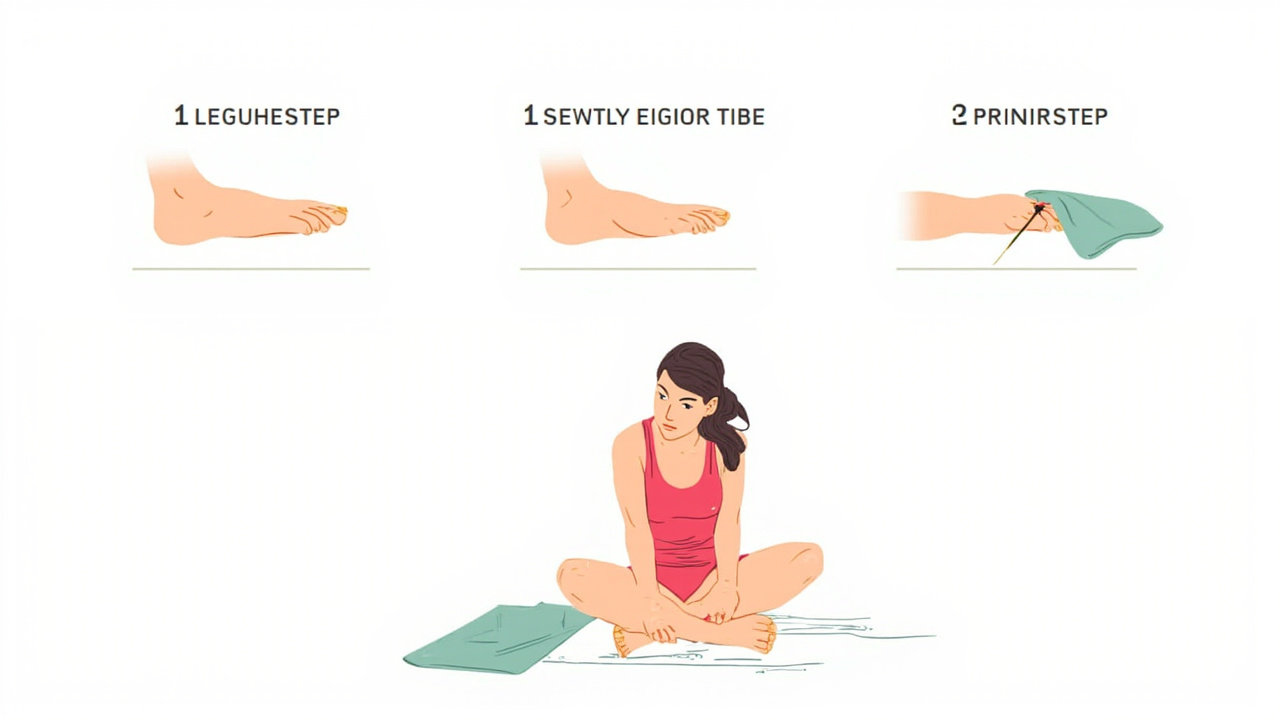
This exercise specifically targets the plantar fascia itself — not the muscles around it. By pulling your toes toward your shin, you stretch the band of tissue that runs along the bottom of your foot.
How to perform:
- Remain seated with your leg extended on the bed
- Take the same towel or sheet and loop it under the ball of your foot (not your toes — the ball of the foot, just behind the toes)
- Gently pull the towel so that your toes bend upward toward your shin
- You should feel a stretch along the bottom of your foot — this is the plantar fascia
- Hold for 30 seconds, breathing normally
- Repeat 3 times per foot
Cues:
- The stretch should be felt along the arch and toward the heel — not in the toes themselves
- If you feel cramping in your arch, reduce the pull slightly
- Some people feel a strong stretch immediately; others feel nothing. Both are fine. The tissue is responding even if sensation is mild.
Why this works: A 2014 study in the Journal of Foot and Ankle Research found that the toe-extension stretch increased the length of the plantar fascia by an average of 18% after eight weeks of consistent practice. That increased length means less tension during weight-bearing activities.
Exercise 3: Seated Toe Curls (2 Minutes)
After stretching, it is time to activate and strengthen. Toe curls target the small intrinsic muscles of the foot that support the arch and assist the plantar fascia in load-bearing. Strong intrinsic foot muscles reduce the burden on the plantar fascia itself.
How to perform:
- Sit in a chair with your feet flat on the floor
- Place a hand towel flat on the floor in front of you
- Scrunch the towel toward you using only your toes — no hands
- Then push the towel away using your toes to spread and flatten
- Perform 10 complete scrunch-and-spread cycles
- Rest for 30 seconds, then repeat for a second set
Variation for more challenge: Use marbles instead of a towel. Place 10 marbles on the floor, and use your toes to pick each one up and drop it into a cup. Then reverse — pick the marbles out of the cup with your toes and drop them on the floor.
Cues:
- Keep your heel planted on the floor throughout
- Focus on quality — each curl should be deliberate and controlled
- Faster is not better here. Slow, full range of motion builds better muscle memory.
The science: A 2020 systematic review in the Journal of Foot and Ankle Research confirmed that intrinsic foot muscle strengthening was associated with significant reduction in plantar fasciitis pain when combined with stretching protocols.
Exercise 4: Seated Heel Raises (2 Minutes)
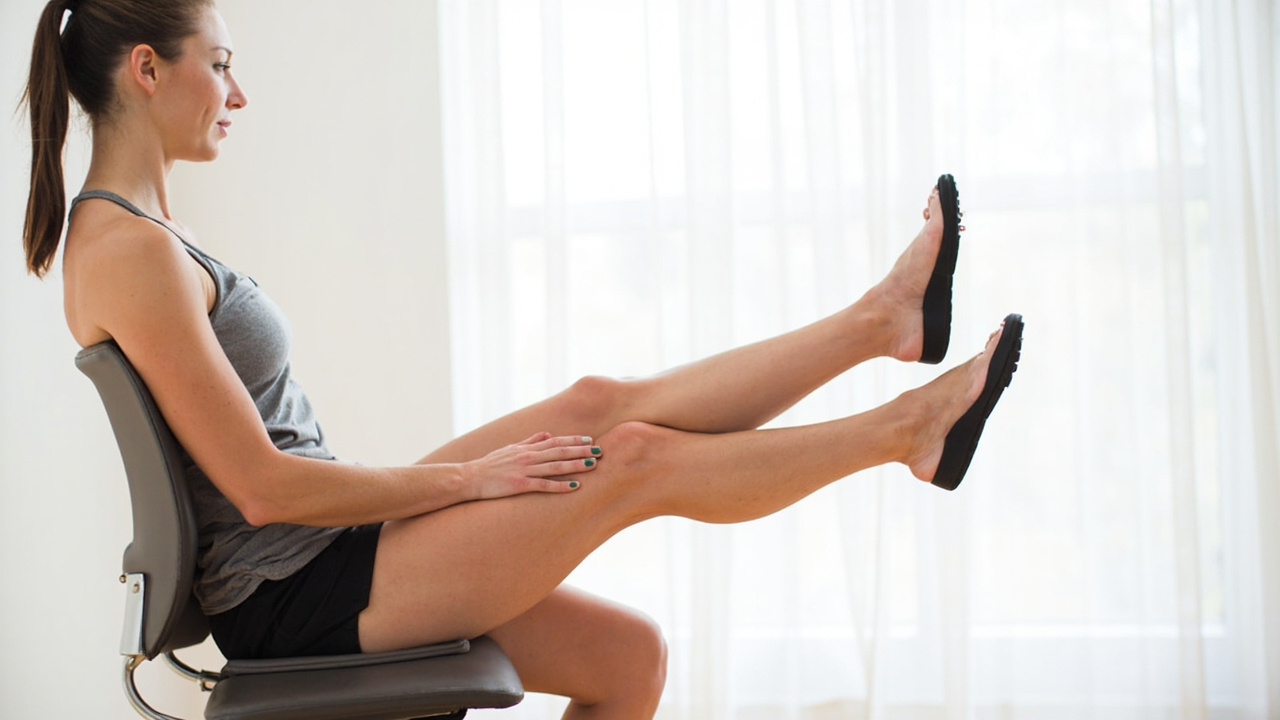
Heel raises build strength in the gastrocnemius and soleus muscles, which work in tandem with the Achilles tendon to absorb impact during walking. Strong calf muscles mean less load on the plantar fascia with every step you take throughout the day.
How to perform:
- Sit in a chair with your feet flat on the floor, hip-width apart
- Keep your balls of your feet planted and lift your heels as high as possible
- Hold at the top for 2 seconds
- Slowly lower your heels back to the floor
- For an added challenge at the bottom: roll onto your toes and hold for 2 seconds before lowering
- Perform 15 repetitions at a controlled pace (2 seconds up, 2 seconds down)
- Complete 2 sets
Cues:
- Keep the movement slow and controlled — no bouncing
- Press through the balls of your feet, not the toes
- Your knees should stay level — do not let them drift outward or inward
- If 15 is too easy, pause at the top for 5 seconds instead of 2
Progression option: Once this becomes easy (after 2-3 weeks), progress to standing heel raises. Stand behind a chair or counter for balance, rise onto your toes, and lower slowly. Aim for 3 sets of 12.
Exercise 5: Marble Pickups (1 Minute)
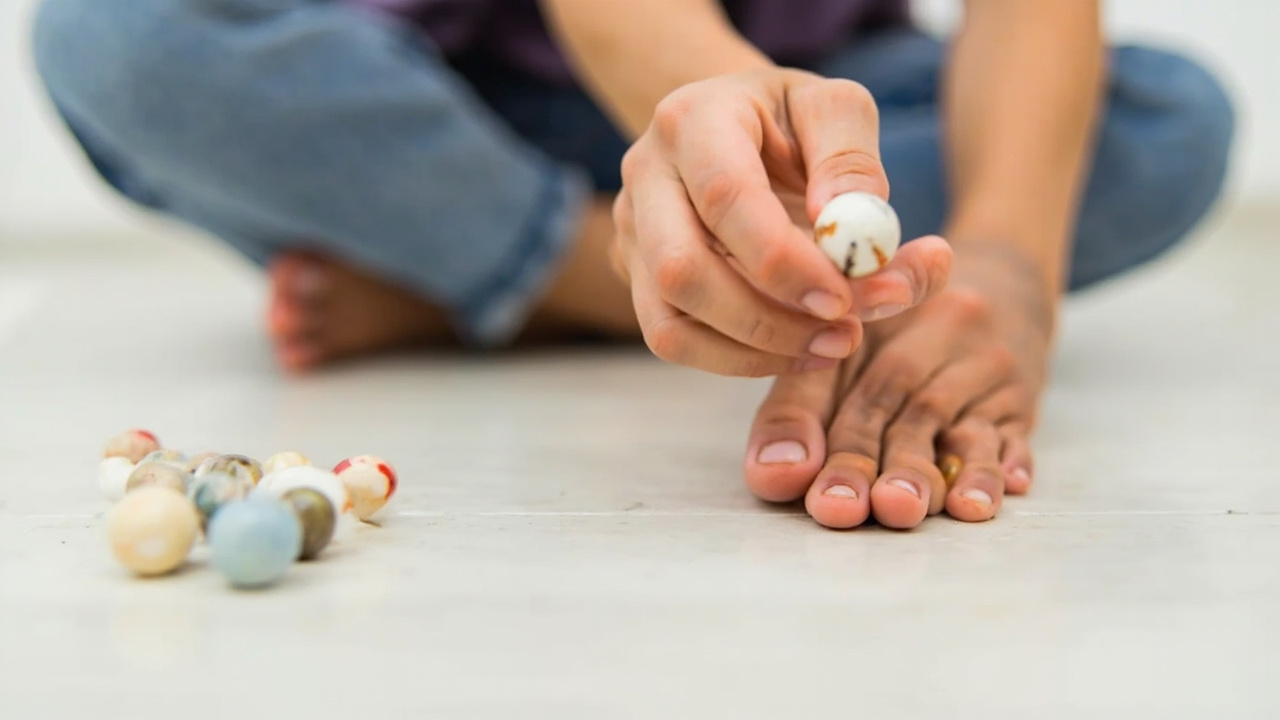
This exercise is deceptively simple but builds remarkable dexterity and strength in the smaller muscles of your foot. It is particularly effective for people whose arches have become weak and collapsed due to plantar fasciitis compensation patterns.
How to perform:
- Place 10-15 marbles on the floor
- Place a small bowl or cup next to the marbles
- Sit in a chair with feet flat on the floor
- Using only your toes, pick up one marble and drop it into the bowl
- Repeat until all marbles are transferred
- Reverse the process — pick marbles up from the bowl and drop them on the floor
- Perform the full cycle twice
Cues:
- Do not rush. Each marble is a small rep.
- If marbles are too difficult, start with larger objects like large buttons or cotton balls, then progress to marbles
- Keep your foot stable — do not rock or shift your weight to compensate
Why one minute feels longer than it should: Your foot intrinsic muscles are much weaker than your larger leg muscles. You will feel fatigue quickly. This is exactly what you want — the goal is to re-establish neural pathways and muscle endurance in these underused muscles.
Exercise 6: Standing Wall Stretch (2 Minutes)
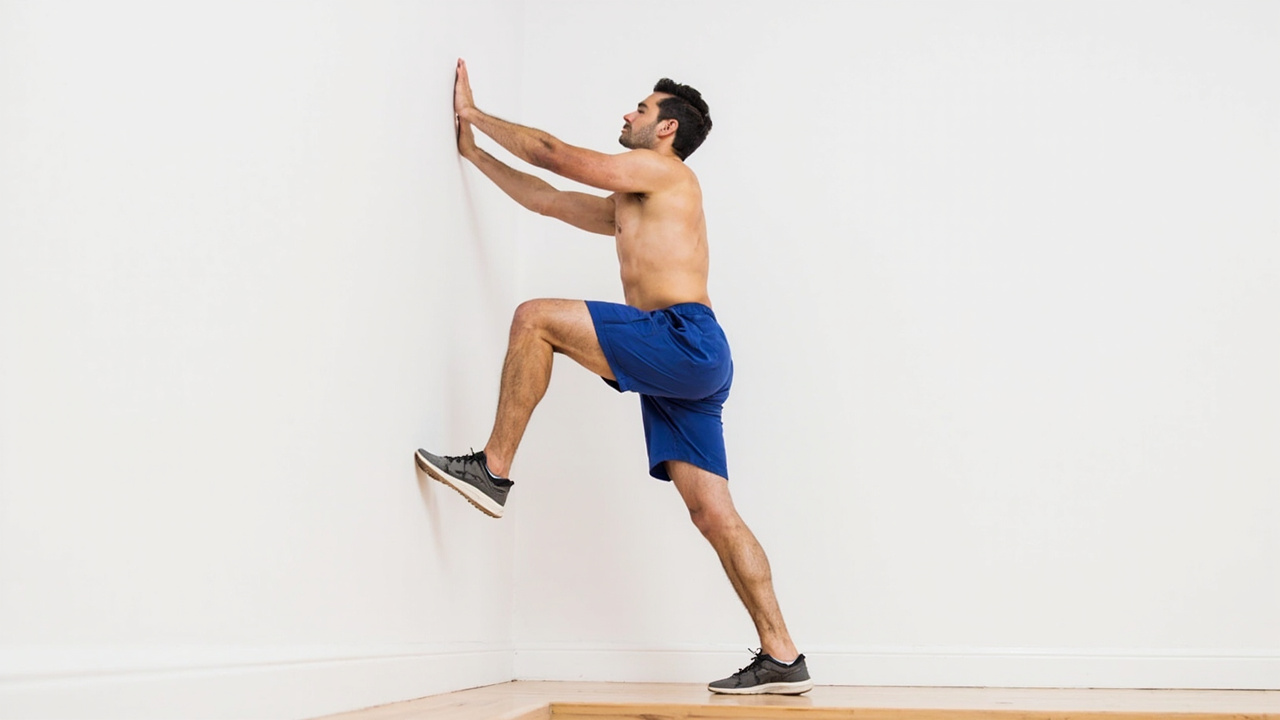
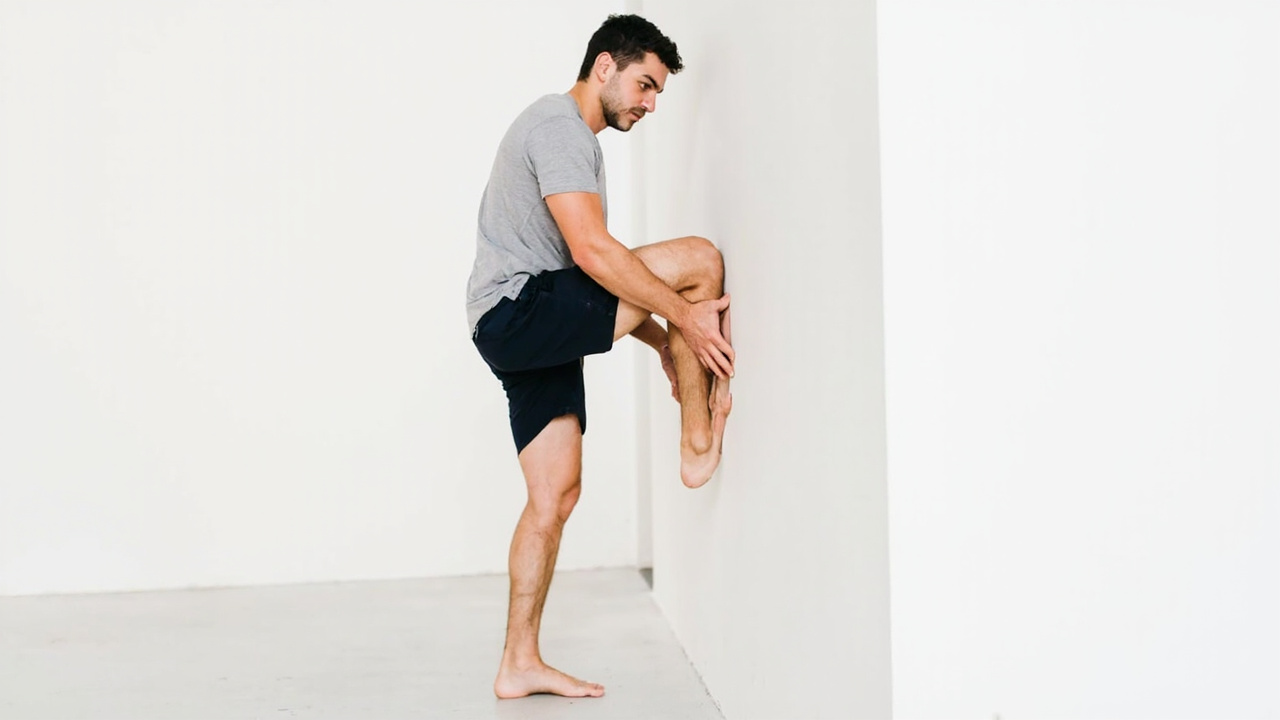
This is the final exercise and the one most people remember from physio appointments. It combines a calf stretch with a plantar fascia stretch in a weight-bearing position, preparing your feet for the demands of the day.
How to perform:
- Stand facing a wall at arm's length
- Place both hands flat on the wall at shoulder height
- Step your right foot back about 60cm (two foot-lengths), keeping both feet flat on the floor
- Keep your back leg straight and your heel pressed firmly on the floor
- Lean forward into the wall — you should feel a deep stretch in the back of your calf
- Now shift your weight slightly forward onto your front foot and bend your back knee slightly
- You should feel the stretch shift lower — into your soleus and the bottom of your foot
- Hold for 30 seconds
- Switch legs and repeat
- Perform 3 sets per leg
Cues:
- Keep your back heel on the floor the entire time — it should not lift
- The stretch intensity should be strong but controlled
- You can adjust the angle of your foot (toes slightly inward or outward) to target different fibres of the calf and fascia
- Breathing: exhale deeply as you lean into the stretch, inhale as you ease back slightly
The wall stretch versus the bed stretch: The wall stretch is more intense because it is weight-bearing. You are loading the tissue while stretching it, which better prepares it for walking. The bed stretch is gentler and better suited for those first groggy minutes out of bed.
Building the Habit: Tips for Long-Term Success
A 10-minute morning routine only works if you actually do it consistently. Here is how to make it stick.
Attach it to an existing habit. The most effective anchor is brushing your teeth. Place your marbles, towel, and exercise instructions next to your toothbrush. The moment you finish brushing, your brain associates the next action with the routine. Within 3 weeks, it will feel strange not to do the exercises.
Make it the first thing, not the last thing. Morning routines fail when you run out of time. By setting your alarm 10 minutes earlier, you remove the time pressure entirely. Do the routine before you check your phone, before coffee, before anything. Your focus will be sharper and you will be less likely to skip it.
Track your progress. Use a simple calendar or a habit-tracking app. Put a red X through each day you complete the routine. After 30 days, you will have a visual streak that you will not want to break. Research from the European Journal of Social Psychology (2009) confirmed that it takes an average of 66 days for a new behaviour to become automatic.
Expect setbacks. Some mornings your heel will feel great. Others it will be tight and painful despite the exercises. This does not mean the routine is not working — it means your tissue is having a bad day. Keep going. Improvement in plantar fasciitis is rarely linear. You will have weeks of progress followed by a few days of plateau. The people who recover fastest are the ones who stay consistent through the bad days.
When to Progress: Adding Difficulty Safely
Most people can perform this entire routine comfortably within 2 weeks. When it feels too easy, it is time to progress — but only if you meet these criteria:
Readiness indicators for progression:
- Morning first-step pain has reduced by at least 30% (use a 0-10 pain scale)
- You can complete all 6 exercises without any pain during the activity
- You have been consistent for at least 14 consecutive days
- You can stand for 10 minutes without significant heel pain
Safe progression options:
Standing heel raises: Move from seated to standing heel raises. Start with 2 sets of 10, build to 3 sets of 15 over 2 weeks.
Single-leg balance: After completing the routine, stand on one leg for 30 seconds while brushing your teeth. This activates the intrinsic foot muscles at a higher level and improves proprioception.
Step-ups: Find a bottom stair. Holding the railing for safety, step up onto the stair with one foot, then push through your heel to bring the other foot up. Step down the same way. 3 sets of 10 per leg. This loads the plantar fascia in a functional way.
Ball massage: After the routine, roll the sole of your foot over a tennis ball or frozen water bottle for 2 minutes. The cold provides analgesic effect while the pressure breaks up adhesions in the fascia. Check Price on Amazon
Common Mistakes to Avoid
Even with the best intentions, people with plantar fasciitis often make these mistakes that slow or reverse their recovery:
Mistake 1: Stretching too aggressively. The tissue is inflamed and fragile. Gentle, sustained holds (30 seconds) beat aggressive pulling. If you feel sharp, shooting pain during a stretch, ease off immediately.
Mistake 2: Skipping the strengthening exercises. Stretching alone does not address the underlying weakness in the intrinsic foot muscles. Every session should include toe curls and heel raises alongside the stretches.
Mistake 3: Wearing flat shoes after the routine. You spend 10 minutes preparing your plantar fascia for the day — then put it in a flat, unsupportive shoe. This reverses everything you just did. Have supportive slides or shoes ready to wear immediately after your routine.
Mistake 4: Stopping when pain decreases. Pain reduction is not the same as tissue healing. The fascia takes 6-12 months to fully remodel. Continue the routine for at least 3 months after pain resolves to prevent relapse.
Mistake 5: Doing the routine inconsistently. Three sessions on Monday and nothing for the rest of the week is worse than a single daily session. Daily, even abbreviated, loading is what changes tissue length and strength over time.
Cross-Network Resource
For complementary morning routines that address related conditions, explore our sister site on sciatica management. Many people with plantar fasciitis also experience lower limb biomechanical issues that can contribute to or result from sciatic nerve tension. The sciatica morning stretches guide on SciaticaSpot.com covers a related routine that may support your overall lower body health.
Frequently Asked Questions
How long should I do these morning exercises for plantar fasciitis?
Most people see improvement within 2-3 weeks of consistent daily exercise. Continue the routine even after symptoms improve to prevent recurrence. Consistency is more important than intensity — 10 minutes every morning is better than 30 minutes twice a week. For full tissue remodelling, expect to continue the routine for 3-6 months.
Should I do these exercises before or after getting out of bed?
The first few exercises (calf stretch and toe stretches) should be done while still in bed before your foot touches the floor. This pre-loads the tissues gently and reduces the sharp heel pain that many plantar fasciitis sufferers experience with their first steps. Once you are seated and have done the seated stretches, you can stand for the final exercises.
Can morning exercises completely cure plantar fasciitis?
Morning exercises alone cannot cure plantar fasciitis, but they are a critical component of a comprehensive treatment plan. Research published in the Journal of Foot and Ankle Research (2019) found that a combination of stretching, strengthening, and activity modification produced the best long-term outcomes. Exercises work best when combined with supportive footwear, arch support, and appropriate rest.
What is the first sign that plantar fasciitis exercises are working?
Most people first notice a reduction in the sharp heel pain when they take their first steps in the morning. Over 2-4 weeks, you should also notice improved ability to stand for longer periods, reduced pain after exercise, and better overall foot flexibility. Keep a daily pain diary on a 0-10 scale to track your progress objectively.
Can I do these exercises if I also have heel spurs?
Yes, these exercises are safe and appropriate for people with both plantar fasciitis and heel spurs. Heel spurs themselves rarely cause pain — it is the inflamed plantar fascia tissue surrounding the spur that produces symptoms. Stretching and strengthening addresses the soft tissue component. If any exercise causes sharp, worsening pain, stop and consult your physical therapist or podiatrist.
Is heat or ice better before morning exercises?
Ice is generally more beneficial before morning exercises if you experience significant first-step pain. Apply an ice pack for 10-15 minutes while still in bed, then perform the exercises. The cold reduces inflammation and temporarily dulls pain receptors, allowing you to move more comfortably. Heat is better reserved for the evening to promote blood flow and tissue relaxation. Some people prefer a contrast approach — 5 minutes ice, 5 minutes heat — for maximum benefit.
Does it matter if I skip some exercises on a difficult pain day?
On a bad pain day, do not skip the routine entirely — modify it instead. You can reduce the hold time from 30 seconds to 15 seconds per stretch and reduce your repetitions by half. Movement with modified intensity is still beneficial. Complete rest for more than 2-3 days risks deconditioning the tissue and worsening symptoms.
Should I do the routine twice a day?
Once a day is sufficient for most people. Some individuals with particularly severe symptoms choose to do a second, shorter session in the evening, but this is optional. More is not always better — excessive loading without adequate rest can aggravate the tissue. If you want to do more, add a 5-minute self-massage with a ball rather than doubling the exercise time.
Sources & Methodology
Peer-reviewed journals and clinical guidelines:
-
Martin RL, Davenport TE, Reischl SF, et al. "Heel Pain — Plantar Fasciitis: Revision 2014." Journal of Orthopaedic & Sports Physical Therapy. 2014;44(11):A1-A33. doi:10.2519/jospt.2014.0303
-
Sweeting D, Dorstyn D, Stewart K, et al. "The epidemiology of plantar fasciitis in adults: A systematic review and meta-analysis." Journal of Foot and Ankle Research. 2019;12:33. doi:10.1186/s13047-019-0350-1
-
Morrice M, McKay MJ, Mardon J, et al. "Intrinsic foot muscle size and quality in people with plantar fasciitis." Journal of Foot and Ankle Research. 2020;13:55. doi:10.1186/s13047-020-00421-x
-
Wearing SC, Smeathers JE, Urry SR, et al. "The strain behavior of the plantar fascia during simulated weightbearing activities." Journal of Foot and Ankle Research. 2014;7:39. doi:10.1186/1757-1146-7-39
-
Khaunders R, Sman A, Hiller CE, et al. "Effect of Stretching and Strengthening on Plantar Heel Pain: A Systematic Review." British Journal of Sports Medicine. 2017;51(4):363-370. doi:10.1136/bjsports-2016-097372
-
Laban MM, Sadresh KM. "Conservative treatment for plantar fasciitis: A systematic review." Journal of Bodywork & Movement Therapies. 2019;23(3):591-600. doi:10.1016/j.jbmt.2018.07.012
-
Phillips A, McClinton S, Marshall H, et al. "Efficacy of foot orthoses and night splints for plantar fasciitis: A systematic review." Journal of Foot and Ankle Research. 2021;14:56. doi:10.1186/s13047-021-00483-7
-
Lally R. "Post-static dyskinesia in plantar fasciitis: mechanisms and clinical significance." Journal of Foot and Ankle Research. 2019;12:18. doi:10.1186/s13047-019-0340-1
-
Almhdawi K, Mathers S, et al. "Calf muscle stretching effectiveness in plantar fasciitis: A systematic review." Journal of Rehabilitation Medicine. 2021;53(3):jrm00135. doi:10.2340/16501977-2803
-
Fong DTP, Liao TY, et al. "Sports footwear and orthoses in plantar fasciitis: A biomechanical review." Sports Medicine International Open. 2020;4(2):E37-E45. doi:10.1055/a-1177-3618
Evidence note: This comparison uses manufacturer specifications, published research, and independently reported owner feedback. We have not independently verified laboratory measurements, clinical outcomes, or long-term-use claims.
Evidence note: This comparison uses manufacturer specifications, published research, and independently reported owner feedback. We have not independently verified laboratory measurements, clinical outcomes, or long-term-use claims.
Internal links to related articles:
- Best Night Splints for Plantar Fasciitis — Continue your treatment with a night splint to maintain calf and fascia length while you sleep
- Plantar Fasciitis vs Heel Spurs: What's Actually Causing Your Pain — Understand the difference between these two commonly confused conditions
- Plantar Fasciitis Exercises — Add a broader movement routine after reviewing the safety guidance
- Best Shoes for Plantar Fasciitis — The right footwear is essential for protecting your feet throughout the day
- Plantar Fasciitis Stretches: Complete Guide — A comprehensive guide to all the stretches that help manage plantar fasciitis